
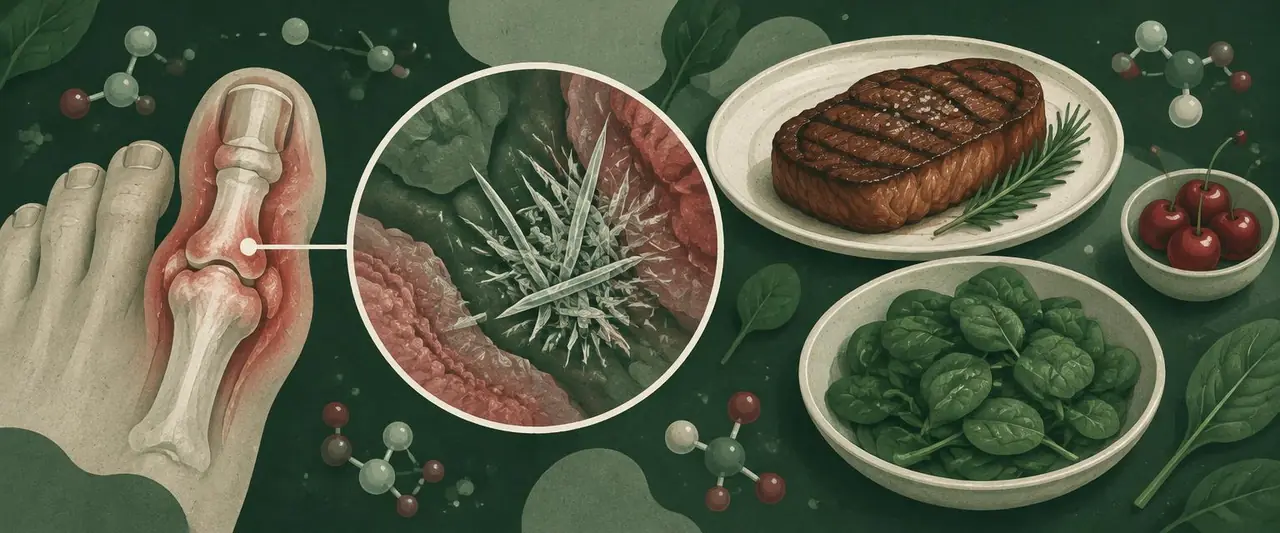
Purines → uric acid → crystals
Your body breaks purines down into uric acid. About two-thirds of it is made by your own body; the rest comes from food. When blood uric acid stays high (above roughly 6.8 mg/dL it can no longer stay dissolved), it can form needle-shaped urate crystals in and around joints. A flare is your immune system attacking those crystals.
The number that matters: under 6
The ACR and EULAR guidelines recommend that people on urate-lowering therapy aim for serum uric acid below 6 mg/dL (some people with tophi are set an even lower target by their doctor). Keeping it there lets existing crystals slowly dissolve. That's why the tracker in this app draws a line at 6.
Food matters, but it isn't everything
Diet typically moves uric acid by a modest amount. For many people, medication prescribed by their doctor does the heavy lifting. Food changes still help: fewer flares, better weight and blood pressure, and fewer triggers to worry about. Think of food as the support act, not the headliner.
Not all purines are equal
In a large study of about 47,000 men (Choi, NEJM 2004), meat and seafood intake was linked to higher gout risk, while purine-rich vegetables like spinach, mushrooms, peas and lentils were not. Organ meats, anchovies and sardines are among the highest-purine foods measured in lab tables.
The sneaky one: fructose
Sugary sodas and fructose-sweetened drinks contain no purines but are linked to higher gout risk, because fructose metabolism produces uric acid. The ACR guideline specifically suggests limiting high-fructose corn syrup.